Jump to HeaderJump to Main ContentJump to Footer
Michigan State University
MSUTODAY
  • Browse Stories By

    Topics

    Explore stories by subject area

    • Arts and Culture
    • Business and Economy
    • Climate and Environment
    • Education and Learning
    • Engineering, Science and Technology
    • Government and Society
    • Health and Medicine
    • Media and Communications
    • MSU Leadership and Impact
    • Sports and Recreation
    • Student and Campus Experience
    View All Stories

    Collections

    Curated story series

    • Turfgrass
    • Ask the Expert
    • Big Ideas
    • Climate solutions
    • Water at MSU
    • Mobility
    • Spartan Perspectives
    • Student views
    • Graduate voices
    • Faculty voices
    View All Collections

    Featured

    Editor's picks

    • The Spartans behind your favorite Michigan golf courses

      July 22, 2026

      The Spartans behind your favorite Michigan golf courses

    • MSU in the 1990s: 10 Spartan milestones

      July 14, 2026

      MSU in the 1990s: 10 Spartan milestones

MSUTODAY
  • Browse Stories By

< Browse Stories By

Topics

Explore stories by subject area

  • Arts and Culture
  • Business and Economy
  • Climate and Environment
  • Education and Learning
  • Engineering, Science and Technology
  • Government and Society
  • Health and Medicine
  • Media and Communications
  • MSU Leadership and Impact
  • Sports and Recreation
  • Student and Campus Experience
  • View All Stories

Collections

Curated story series

  • Turfgrass
  • Ask the Expert
  • Big Ideas
  • Climate solutions
  • Water at MSU
  • Mobility
  • Spartan Perspectives
  • Student views
  • Graduate voices
  • Faculty voices
  • View All Collections

Featured

Editor's picks

  • The Spartans behind your favorite Michigan golf courses

    July 22, 2026

    The Spartans behind your favorite Michigan golf courses

  • MSU in the 1990s: 10 Spartan milestones

    July 14, 2026

    MSU in the 1990s: 10 Spartan milestones

  • For Media
  • Experts
  • Releases and Statements
  • Sign Up
  • Update Information
Michigan State University

Resources

  • A to Z Index
  • Find People
  • Maps
  • Email
  • Student Information System (SIS)
  • D2L
  • Libraries
  • Tech Support
  • MSU Misconduct Hotline
  • Social Media Directory
  • Events Calendar
  • For Media
Michigan State University
MSUToday
  • For Media
  • Experts
  • Releases and Statements
  • Sign Up
  • Update Information
Mental Health

Sept. 15, 2020

Illuminating the opaque pathways of depression

Depression is a dark horse.

The disease often goes unnoticed, but affects work performance, social interaction and the ability to take pleasure in everyday life. According to the National Center for Biotechnology Information, antidepressants only help around 50 percent of those who struggle with depression and anxiety and, even when they are effective, scientists have yet to understand how they work in the brain.

alt=
MSU associate professor of physiology A.J. Robison and his lab used new CRISPR-based technology to uncover pathways of depression-like behavior in the mouse brain. Credit: College of Natural Science

But groundbreaking research in the lab of Michigan State University scientist A.J. Robison, associate professor in the Department of Physiology and MSU’s Neuroscience Program, is directing some new rays of light onto the molecular, cellular and circuit-level mechanisms underlying depression-like diseases.

The results were recently published in Nature Communications.

“In this paper, we perform the first ever CRISPR-based gene editing [a genetic engineering technique in molecular biology by which the genomes of living organisms may be modified] in a single circuit between two areas of the mouse brain,” explained Robison about the culmination of five years of research funded by the National Institutes of Mental Health. “We can reach into the mouse brain and manipulate specific genes in a circuit involved in depression and anxiety-like behaviors — a critical advance on the road to genetic medicine for psychiatric diseases.”

Scientists estimate there are roughly 80-100 billion neurons connecting regions of the brain. To accomplish the feat of locating and manipulating a single gene in a single circuit required new and sophisticated technology. With the expertise of co-author Rachael Neve, director of the Gene Transfer Core at Massachusetts General Hospital, they developed it.

“The key advance is that we designed a dual-vector system to manipulate a specific gene in the connections between two brain areas, and that has never been done before,” Robison said.
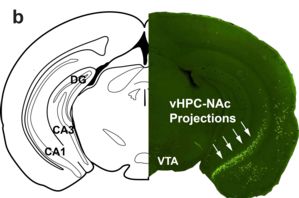
Mouse brain partially colored in green. Text reads
Cross section of a mouse brain. The projections of the cells between the vHPC and NAc, shown here in neon green, are manipulated by the new CRISPR viral vector-based technology developed by Rachael Neve and the Robison Lab. Credit: Andrew Eagle

The neurons that Robison and his team zeroed in on originate in the ventral hippocampus (vHPC), a deep-seated structure that projects to regions in the brain important in stress susceptibility, mood and social avoidance. Neurons rooted in the vHPC reach out with branch-like structures called axons to connect with the nucleus accumbens, or NAc. The completed circuit is regulated by the star of the pioneering paper, the transcription factor known as DFosB.

Using the viral vector technology specifically designed and packaged by Neve, the team split the CRISPR system in half. Half of the system, inert on its own, was an enzyme that can mutate DNA in the vHPC. The other half, a guide RNA, was sent to all cells that project to the NAc and tells the enzyme where to bind and the specific gene to mutate. Only those cells specific to the circuit from the vHPC to the NAc got both halves, triggering the enzyme to bind with and turn off a single gene: FosB.

“When the FosB gene was turned off in the neurons, we were able to get a circuit-specific behavioral effect relevant to a disease like depression,” said Robison about the landmark discovery. “When we put it back, or rescued it within the circuit, the effect was erased.”

alt=
Claire Manning was a key contributor to the groundbreaking study and is now a postdoctoral researcher at Stanford University. Credit: Ken Moon

“One of the most exciting findings from our investigations was the circuit-specific role of the ΔFosB protein in conferring resilience to stress,” Eagle said. “We also discovered that ΔFosB altered the excitability of hippocampal circuit neurons and may be affecting long-term downstream changes that lead to changes in the activity of this circuit.” But removing DFosB permanently altered the expression of a suite of genes, in effect removing the conductor from the orchestra. To that end, the paper goes on to report in-depth experiments on DFosB largely done by the members of the Robison Lab including co-first authors Claire Manning, a 2019 neuroscience graduate, now a postdoc at Stanford University; and Andrew Eagle, a former postdoctoral researcher, now an assistant professor in the MSU Department of Physiology.
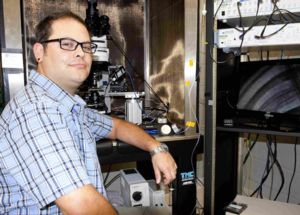
alt=
Andrew Eagle, shown here imaging a mouse brain, played a major role in conducting experiments to further probe the function of DFosB. Credit: Research@MSU.

Based on the findings in the paper, the Robison Lab will continue to develop highly collaborative and cutting-edge techniques, accelerated by MSU’s newly completed Interdisciplinary Science and Technology Building. “This work is important because it elucidates a potential mechanism, namely ΔFosB, for how stress may contribute to depression,” Eagle continued. “Future clinical work may find ways to directly manipulate ΔFosB, or more likely one of its gene targets, to provide resilience to stress and decrease the incidence of depression in vulnerable people.”

“The end of this paper, which shows us measuring the changes of expression in hundreds of genes when we remove DFosB, is only the beginning of years of work for our lab,” Robison said. “Which genes are important and what are they doing in the brain? This is the challenge of a lifetime for me and my lab.” 

This article is repurposed content originally featured on the College of Natural Sciences website.


 

MEDIA CONTACTS

Val Osowski
Mental HealthHealth and MedicineMSU ResearchMSU Leadership and ImpactHealth and Medicine

Latest News

MSUToday Weekly Update

The MSUToday Weekly Update email showcases how Spartans are making a difference through academic excellence, research impact and community outreach. Get inspired by these stories of innovation, collaboration and determination. Plus, enjoy photos and videos of campus and more MSU content to help keep you connected to the Spartan community.

Sign UpUpdate My Information

Connect With Us

Visit our Facebook pageVisit our page on XVisit our Instagram pageVisit our LinkedIn pageVisit our YouTube pageVisit our TikTok page

Health and Safety

  • MSU Police and Public Safety
  • Olin Health Center
  • Counseling & Psychiatric Services (CAPS)
  • University Health and Wellbeing
  • MSU Health Care
  • Civil Rights and Title IX
  • Our Commitment
  • Center for Survivors
  • Security & Fire Safety Report
  • University Policy on Relationship Violence and Sexual Misconduct
  • Notice of Non-Discrimination, Anti-Harassment and Non-Retaliation
  • Health Care Non-Discrimination Notice

Support Services

  • Disability Resources
  • Supportive Services
  • Learning Resources

Working at MSU

  • Human Resources
  • EBS Login
  • Job Postings
  • Employee Assistance Program

Reports

  • CARES Act Funding
  • Student Achievement and Outcomes

Contact us

517-355-1855

Address

Michigan State University 426 Auditorium Road East Lansing, MI 48824

Follow Us

  • Visit our Facebook page
  • Visit our page on X
  • Visit our Instagram page
  • Visit our TikTok page
  • Visit our LinkedIn page
  • Visit our YouTube page

If you're having accessibility issues, please let us know.

Know More: Campus Safety Information and ResourcesTransparency Reporting: Budget & Salary/Compensation
Michigan State University
  • Contact Information|
  • Site Map|
  • Privacy Statement|
  • Site Accessibility|
  • Call MSU: (517) 355-1855|
  • Visit: msu.edu|
  • Notice of Nondiscrimination|

SPARTANS WILL|© Michigan State University|