Jump to HeaderJump to Main ContentJump to Footer
Michigan State University
  • Browse Stories By

    Topics

    Explore stories by subject area

    • Arts and Culture
    • Business and Economy
    • Climate and Environment
    • Education and Learning
    • Engineering, Science and Technology
    • Government and Society
    • Health and Medicine
    • Media and Communications
    • MSU Leadership and Impact
    • Sports and Recreation
    • Student and Campus Experience
    View All Stories

    Collections

    Curated story series

    • Turfgrass
    • Ask the Expert
    • Big Ideas
    • Climate solutions
    • Water at MSU
    • Mobility
    • Spartan Perspectives
    • Student views
    • Graduate voices
    • Faculty voices
    View All Collections

    Featured

    Editor's picks

    • The Spartans behind your favorite Michigan golf courses

      July 22, 2026

      The Spartans behind your favorite Michigan golf courses

    • MSU in the 1990s: 10 Spartan milestones

      July 14, 2026

      MSU in the 1990s: 10 Spartan milestones

MSUTODAY
  • Browse Stories By

< Browse Stories By

Topics

Explore stories by subject area

  • Arts and Culture
  • Business and Economy
  • Climate and Environment
  • Education and Learning
  • Engineering, Science and Technology
  • Government and Society
  • Health and Medicine
  • Media and Communications
  • MSU Leadership and Impact
  • Sports and Recreation
  • Student and Campus Experience
  • View All Stories

Collections

Curated story series

  • Turfgrass
  • Ask the Expert
  • Big Ideas
  • Climate solutions
  • Water at MSU
  • Mobility
  • Spartan Perspectives
  • Student views
  • Graduate voices
  • Faculty voices
  • View All Collections

Featured

Editor's picks

  • The Spartans behind your favorite Michigan golf courses

    July 22, 2026

    The Spartans behind your favorite Michigan golf courses

  • MSU in the 1990s: 10 Spartan milestones

    July 14, 2026

    MSU in the 1990s: 10 Spartan milestones

  • For Media
  • Experts
  • Releases and Statements
  • Sign Up
  • Update Information

Resources

  • A to Z Index
  • Find People
  • Maps
  • Email
  • Student Information System (SIS)
  • D2L
  • Libraries
  • Tech Support
  • MSU Misconduct Hotline
  • Social Media Directory
  • Events Calendar
  • For Media
Michigan State University
MSUToday
  • For Media
  • Experts
  • Releases and Statements
  • Sign Up
  • Update Information
MSUTODAY
Natural Sciences

Nov. 19, 2020

MSU researchers discover 'missing' piece of Hawaii's formation

By: Emilie Lorditch

An oceanic plateau has been observed for the first time in Earth’s lower mantle, 800 kilometers deep underneath Eastern Siberia, pushing Hawaii’s birthplace back to 100 million years, says a Michigan State University geophysicist.

The discovery came when Songqiao “Shawn” Wei, an Endowed Assistant Professor of Geological Sciences in MSU’s Department of Earth and Environmental Sciences, noticed something unusual in his data using groundbreaking techniques. Wei’s research will be published on Nov. 20 in the journal Science.

Earth’s mantle is mostly solid, but at a mid-ocean ridge it melts creating new oceanic crust between two tectonic plates such as the Pacific Plate. Typically, this new Pacific Ocean crust has a uniform thickness of four miles, Wei said.

As the plates continue to move, a hot plume of solid rocks slowly rises in the mantle melting the tectonic plate to create volcanoes like the Hawaiian Islands. The mantle plume has a mushroom-like shape with a wide head that is thousands of miles across and a thin tail that is only of a few hundred miles across.  

Wei said once this mushroom head reaches Earth’s surface in the ocean, it stretches and flattens out, while it melts the overriding tectonic plate to form a pancake-shaped 20-mile-thick oceanic plateau. This process continues as more of the mantle reaches the surface and the overriding plate continues to move. Over time, what remains is a dotted trail of islands. 
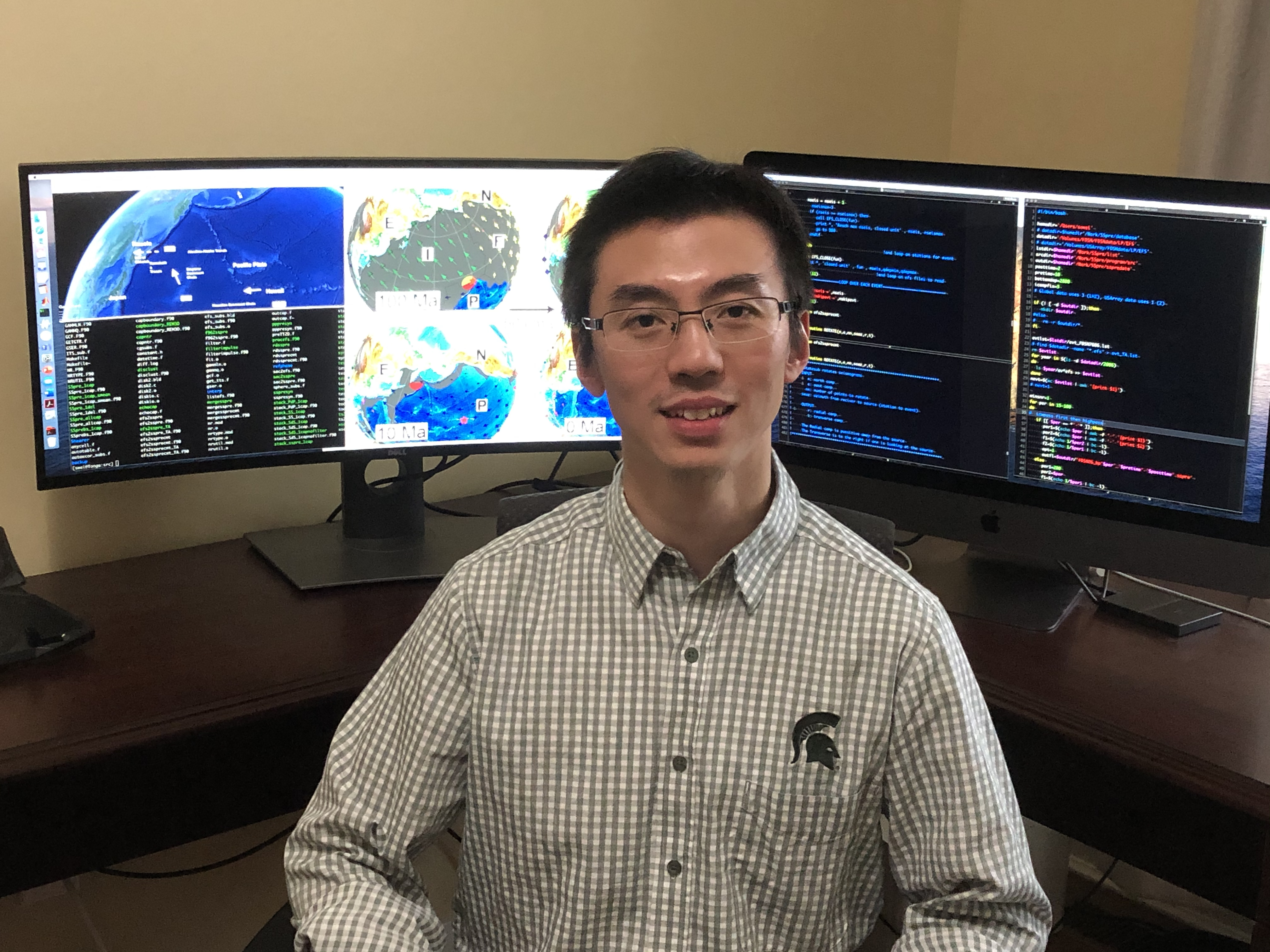
Songqiao
Songqiao "Shawn" Wei Courtesy of Yolanda Yue

“Normally, you would see a pancake-shaped oceanic plateau created by the mushroom's head followed by a dotted chain of islands created by the mushroom’s tail,” Wei said. “The Hawaiian Islands are the end of the tail but where is Hawaii’s pancake head?” 

There are still debates on whether every mantle plume creates a “pancake” during its earliest history, and the ultimate destination of these pancake-shaped oceanic plateaus. Trying to find ancient oceanic crust, including old oceanic plateaus, is difficult because the crust might have subducted or slid into or underneath an oceanic trench and disappeared from Earth’s surface. 

Although scientists generally believe the oceanic crust is preserved in Earth’s mantle after subduction, it is usually too thin to be observed using conventional technology, such as seismic tomography. Up until now, this is what Wei thought happened to Hawaii’s “pancake” until he detected a surprising signal in the data. 

“I spotted an unusually thick chunk of oceanic crust about 500 miles beneath Earth’s surface,” he said. “The thickness of this piece of crust made it distinguishable, but it was still too thin and too deep to be easily found.”

Wei and his team compiled the largest dataset of a specific type of seismograms and conducted big data analysis and numerical simulations on the High-Performance Computing Cluster managed by the MSU Institute for Cyber-Enabled Research. His collaborators include: Peter M. Shearer from Scripps Institute of Oceanography; Carolina Lithgow-Bertelloni and Lars Stixrude from the University of California, Los Angeles; and Dongdong Tian from MSU.

The team also combined the strengths of seismic tomography, seismic reflection and mineral physics. Seismic tomography from previously published work creates a 3-D image which revealed a vague image of the ancient Pacific Plate in the mantle. Seismic reflection results —the core observation of this work—helped the researchers find the thick crust at great depths. Mineral physics was used by the team to prove that the detected signal indicates a piece of oceanic plateau. 

Plate reconstruction modeling helped the researchers link the newly found oceanic plateau to the Hawaiian “pancake” that was created during the formation of the Hawaii hotspot approximately 100 million years ago. 

One hypothesis is that the Hawaii “pancake” broke into two pieces. 

One piece was part of the Izanagi Plate which subducted into the Aleutian Trench and disappeared about 70-80 million years ago. The other piece was part of the Pacific Plate and after it entered the Kamchatka Trench 20-30 million years ago, the heavy oceanic crust sunk deep into Earth’s mantle later until Wei and his team spotted it. 

This discovery not only provides clues of Hawaii’s early history, but also sheds light on the evolution of other hotspots, seamounts and oceanic plates. The researchers plan to use this new technique combining seismic tomography, seismic reflection and mineral physics to find other “missing pancakes” and to continue looking for evidence of older pieces of Earth’s oceanic crust in the deep Earth.
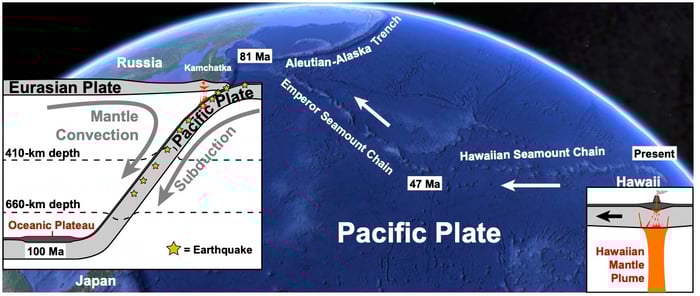
  

From mantle plume, under Pacific plate and sink into the mantle

The journey of Hawaii's pancake from its creation at the mantle plume to where it slipped under the Pacific plate and sunk deep into the Earth's mantle.


 

MEDIA CONTACTS

Caroline Brooks
Natural SciencesEngineering, Science and TechnologyNatural Resources and ConservationClimate and Environment

Latest News

MSUToday Weekly Update

The MSUToday Weekly Update email showcases how Spartans are making a difference through academic excellence, research impact and community outreach. Get inspired by these stories of innovation, collaboration and determination. Plus, enjoy photos and videos of campus and more MSU content to help keep you connected to the Spartan community.

Sign UpUpdate My Information

Connect With Us

Visit our Facebook pageVisit our page on XVisit our Instagram pageVisit our LinkedIn pageVisit our YouTube pageVisit our TikTok page

Health and Safety

  • MSU Police and Public Safety
  • Olin Health Center
  • Counseling & Psychiatric Services (CAPS)
  • University Health and Wellbeing
  • MSU Health Care
  • Civil Rights and Title IX
  • Our Commitment
  • Center for Survivors
  • Security & Fire Safety Report
  • University Policy on Relationship Violence and Sexual Misconduct
  • Notice of Non-Discrimination, Anti-Harassment and Non-Retaliation
  • Health Care Non-Discrimination Notice

Support Services

  • Disability Resources
  • Supportive Services
  • Learning Resources

Working at MSU

  • Human Resources
  • EBS Login
  • Job Postings
  • Employee Assistance Program

Reports

  • CARES Act Funding
  • Student Achievement and Outcomes

Contact us

517-355-1855

Address

Michigan State University 426 Auditorium Road East Lansing, MI 48824

Follow Us

  • Visit our Facebook page
  • Visit our page on X
  • Visit our Instagram page
  • Visit our TikTok page
  • Visit our LinkedIn page
  • Visit our YouTube page

If you're having accessibility issues, please let us know.

Know More: Campus Safety Information and ResourcesTransparency Reporting: Budget & Salary/Compensation
  • Contact Information|
  • Site Map|
  • Privacy Statement|
  • Site Accessibility|
  • Call MSU: (517) 355-1855|
  • Visit: msu.edu|
  • Notice of Nondiscrimination|

SPARTANS WILL|© Michigan State University|