Jump to HeaderJump to Main ContentJump to Footer
Michigan State University
  • Browse Stories By

    Topics

    Explore stories by subject area

    • Arts and Culture
    • Business and Economy
    • Climate and Environment
    • Education and Learning
    • Engineering, Science and Technology
    • Government and Society
    • Health and Medicine
    • Media and Communications
    • MSU Leadership and Impact
    • Sports and Recreation
    • Student and Campus Experience
    View All Stories

    Collections

    Curated story series

    • Turfgrass
    • Ask the Expert
    • Big Ideas
    • Climate solutions
    • Water at MSU
    • Mobility
    • Spartan Perspectives
    • Student views
    • Graduate voices
    • Faculty voices
    View All Collections

    Featured

    Editor's picks

    • The Spartans behind your favorite Michigan golf courses

      July 22, 2026

      The Spartans behind your favorite Michigan golf courses

    • MSU in the 1990s: 10 Spartan milestones

      July 14, 2026

      MSU in the 1990s: 10 Spartan milestones

MSUTODAY
  • Browse Stories By

< Browse Stories By

Topics

Explore stories by subject area

  • Arts and Culture
  • Business and Economy
  • Climate and Environment
  • Education and Learning
  • Engineering, Science and Technology
  • Government and Society
  • Health and Medicine
  • Media and Communications
  • MSU Leadership and Impact
  • Sports and Recreation
  • Student and Campus Experience
  • View All Stories

Collections

Curated story series

  • Turfgrass
  • Ask the Expert
  • Big Ideas
  • Climate solutions
  • Water at MSU
  • Mobility
  • Spartan Perspectives
  • Student views
  • Graduate voices
  • Faculty voices
  • View All Collections

Featured

Editor's picks

  • The Spartans behind your favorite Michigan golf courses

    July 22, 2026

    The Spartans behind your favorite Michigan golf courses

  • MSU in the 1990s: 10 Spartan milestones

    July 14, 2026

    MSU in the 1990s: 10 Spartan milestones

  • For Media
  • Experts
  • Releases and Statements
  • Sign Up
  • Update Information

Resources

  • A to Z Index
  • Find People
  • Maps
  • Email
  • Student Information System (SIS)
  • D2L
  • Libraries
  • Tech Support
  • MSU Misconduct Hotline
  • Social Media Directory
  • Events Calendar
  • For Media
Michigan State University
MSUToday
  • For Media
  • Experts
  • Releases and Statements
  • Sign Up
  • Update Information
MSUTODAY
Health Professions

Dec. 9, 2020

Study connects diabetes, air pollution to interstitial lung disease

By: Emily Lenhard
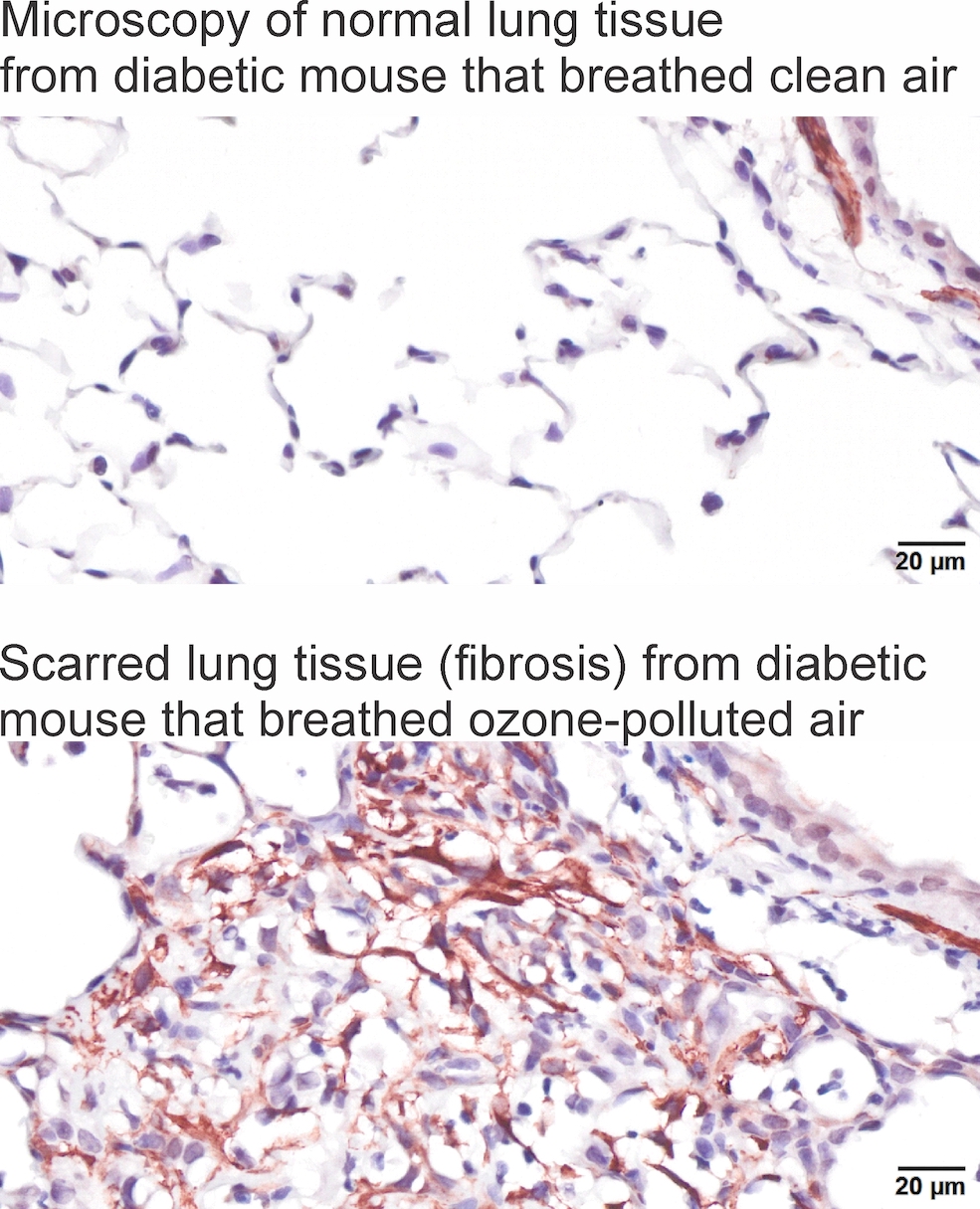
A side-by-side comparison of a normal lung and one with interstitial lung disease.
 

People with prediabetes or diabetes who live in ozone-polluted areas may have an increased risk for an irreversible disease with a high mortality rate. A new study recently published in the Environmental Health Perspectives connects insulin resistance and repetitive ozone exposure to the development of interstitial lung disease.


“Our findings are especially important today as we’re in the midst of the COVID-19 pandemic, where we have great concern regarding the convergence of health effects from air pollution and SARS-CoV-2 in susceptible populations like people with diabetes,” said James Wagner, lead author and associate professor for the MSU College of Veterinary Medicine’s Department of Pathobiology and Diagnostic Investigation.


Ozone – a gas often referred to as “smog” – is known to intensify certain lung diseases, such as asthma and rhinitis, which are primarily upper airway diseases. But recent epidemiology suggests an association between high ozone concentrations and adverse health effects in the deep lung, which cause difficulty breathing due to lung restriction and stiffness.


“More than 170,000 people in the U.S. suffer from interstitial lung disease. Furthermore, Type 2 diabetes and insulin resistance are recently suggested risk factors for developing pulmonary fibrosis,” said Jack Harkema, University Distinguished Professor, Albert C. and Lois E. Dehn Endowed Chair in Veterinary Medicine, and director of the Laboratory for Environmental and Toxicologic Pathology and the Mobile Air Research Laboratories at MSU.


In the study, Wagner, Harkema and their collaborators, Robert Tighe and Christina Barkauskas from Duke University’s Department of Medicine, studied healthy mice, mice with mild insulin resistance and mice with marked insulin resistance. The study found a direct relationship between insulin resistance levels and the severity of lung inflammation and scarring, or fibrosis. Diabetes-prone mice were particularly susceptible to inflammation and tissue remodeling caused by repeated ozone exposure.


“Evidence suggests that ozone exposure could exacerbate pulmonary fibrosis, particularly in individuals that are diabetic,” said Tighe, a pulmonologist who specializes in interstitial disease at Duke. “Poorly controlled diabetes, in particular, may be an important co-morbidity for worsened lung damage.”


According to Wagner, these findings are of critical importance for public health.


“Our results propose a causal link for ozone exposure to preferentially promote early pulmonary fibrosis and lung disease in prediabetic mice. We only exposed these mice for three weeks, but there are millions of people living in cities like Los Angeles and New York who are exposed to high levels of ozone day after day,” he said. “Then, you must consider the prevalence of prediabetes people — approximately 33% in this country. Our study results suggest that people who are borderline insulin resistant — or diabetic — and living in areas with high levels of ozone pollution might be at an increased risk for developing lung disease.”


This study is just the latest in Wagner and Harkema’s research efforts, which describe pre-diabetes as a risk factor for multiple possible adverse responses to air pollution. Wagner has previously shown deleterious effects on heart rate, blood pressure and adipose tissue inflammation in prediabetic rodents that were exposed to ozone.


The authors believe this study is the first of its kind, as it describes aggravated pulmonary inflammation and remodeling due to repetitive, short-term ozone exposures in insulin-resistant rodents that also exhibit other manifestations of Type 2 diabetes. The work was supported in large part by the researchers’ grant from the Environmental Protection Agency’s Great Lakes Air Center for Integrative Environmental Research at MSU.

(Note for media: please include a link to the original paper in online coverage: “Repetitive Ozone Exposures and Evaluation of Pulmonary Inflammation and Remodeling in Diabetic Mouse Strains” — https://ehp.niehs.nih.gov/doi/10.1289/EHP7255)


MEDIA CONTACTS

Caroline Brooks
Health ProfessionsHealth and MedicineDiseases, Conditions and TreatmentsPollutionClimate and Environment

Latest News

MSUToday Weekly Update

The MSUToday Weekly Update email showcases how Spartans are making a difference through academic excellence, research impact and community outreach. Get inspired by these stories of innovation, collaboration and determination. Plus, enjoy photos and videos of campus and more MSU content to help keep you connected to the Spartan community.

Sign UpUpdate My Information

Connect With Us

Visit our Facebook pageVisit our page on XVisit our Instagram pageVisit our LinkedIn pageVisit our YouTube pageVisit our TikTok page

Health and Safety

  • MSU Police and Public Safety
  • Olin Health Center
  • Counseling & Psychiatric Services (CAPS)
  • University Health and Wellbeing
  • MSU Health Care
  • Civil Rights and Title IX
  • Our Commitment
  • Center for Survivors
  • Security & Fire Safety Report
  • University Policy on Relationship Violence and Sexual Misconduct
  • Notice of Non-Discrimination, Anti-Harassment and Non-Retaliation
  • Health Care Non-Discrimination Notice

Support Services

  • Disability Resources
  • Supportive Services
  • Learning Resources

Working at MSU

  • Human Resources
  • EBS Login
  • Job Postings
  • Employee Assistance Program

Reports

  • CARES Act Funding
  • Student Achievement and Outcomes

Contact us

517-355-1855

Address

Michigan State University 426 Auditorium Road East Lansing, MI 48824

Follow Us

  • Visit our Facebook page
  • Visit our page on X
  • Visit our Instagram page
  • Visit our TikTok page
  • Visit our LinkedIn page
  • Visit our YouTube page

If you're having accessibility issues, please let us know.

Know More: Campus Safety Information and ResourcesTransparency Reporting: Budget & Salary/Compensation
  • Contact Information|
  • Site Map|
  • Privacy Statement|
  • Site Accessibility|
  • Call MSU: (517) 355-1855|
  • Visit: msu.edu|
  • Notice of Nondiscrimination|

SPARTANS WILL|© Michigan State University|