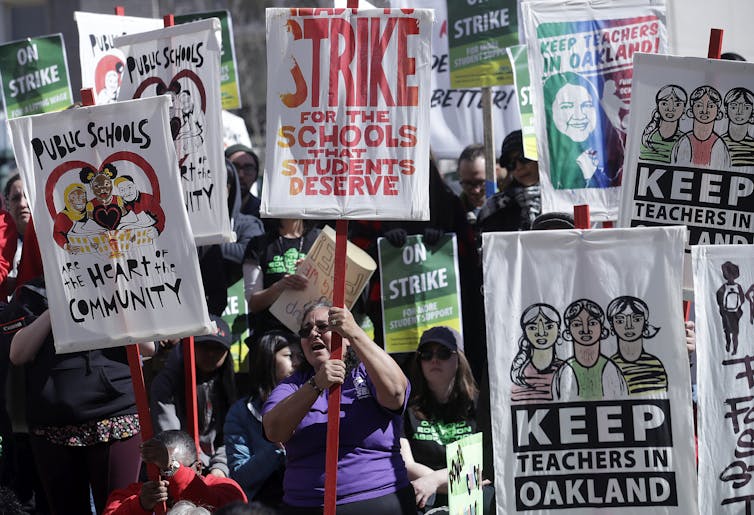
 Teachers, students and supporters rally in front of City Hall in Oakland, Calif., in February. Jeff Chiu/AP Bradley D. Marianno, University of Nevada, Las Vegas and Katharine O. Strunk, Michigan State University
MSU's Katharine O. Strunk, professor of Education Policy and, by courtesy, Economics, the Clifford E. Erickson Distinguished Chair in Education, and Co-Director, Education Policy Innovation Collaborative, College of Education; and Bradley D. Marianno, assistant professor, Educational Leadership & Policy University of Nevada, Las Vegas, wrote this piece for The Conversation, an independent collaboration between editors and academics that provides informed news analysis and commentary to the general public. See the entire list of articles written by MSU faculty for The Conversation.
When schoolteachers in Los Angeles went on a weeklong strike in January, the head of the local teachers union described it as a “battle for the soul of public education.” When Denver public school teachers went on a three-day strike in February, they did it in the name of “schools Denver students deserve.”
When teachers began their strike in Oakland on Feb. 26, the local teachers union repeated this message, voicing that they were “fighting for the schools Oakland students’ deserve” and in a struggle for the “soul of public education.” The Oakland teachers’ strike ended on March 1.
It’s true, many of the demands the unions are making will likely benefit students. But beneath the rallying cries, unions in the public sector are facing a new reality that suggests they are actually fighting for something else.
Ever since the Supreme Court ruled in Janus v. AFSCME in 2018 that workers are free to choose whether to join a union, we’d argue that the teacher strikes have been as much a fight for the soul of the union as they are for the soul of public education. What the teachers’ unions really want and need is membership. As one political science professor told The New York Times: “Members and money are power in politics.”
The deals that teachers’ unions negotiate with school districts matter more than ever for maintaining their membership and political power in the post-Janus world. As education policy scholars who have studied teachers’ unions and teacher collective bargaining for over a decade, we have read thousands of agreements like the ones just negotiated in Los Angeles, Denver and Oakland.
Negotiating for numbers
The agreements that unions are securing establish teacher salaries, restrictions on the length of the workday, performance evaluation procedures and other important working conditions. But they also set staffing levels for teachers, librarians and counselors. In short, if unions can win at the bargaining table they can increase staffing. And if they can increase staffing, they can increase membership and ensure their future.
Consider the deal that the teachers’ union secured in Los Angeles. Along with a 6 percent salary increase – basically the school district’s offer long before the final contract was signed – the deal includes numerous staffing guarantees that equate to more membership for the Los Angeles teachers’ union: 300 nurses, 82 librarians, 77 counselors. The contract reduces class size by four students in grades 4 through 12 over the duration of the contract, requiring the school district to add new teachers.
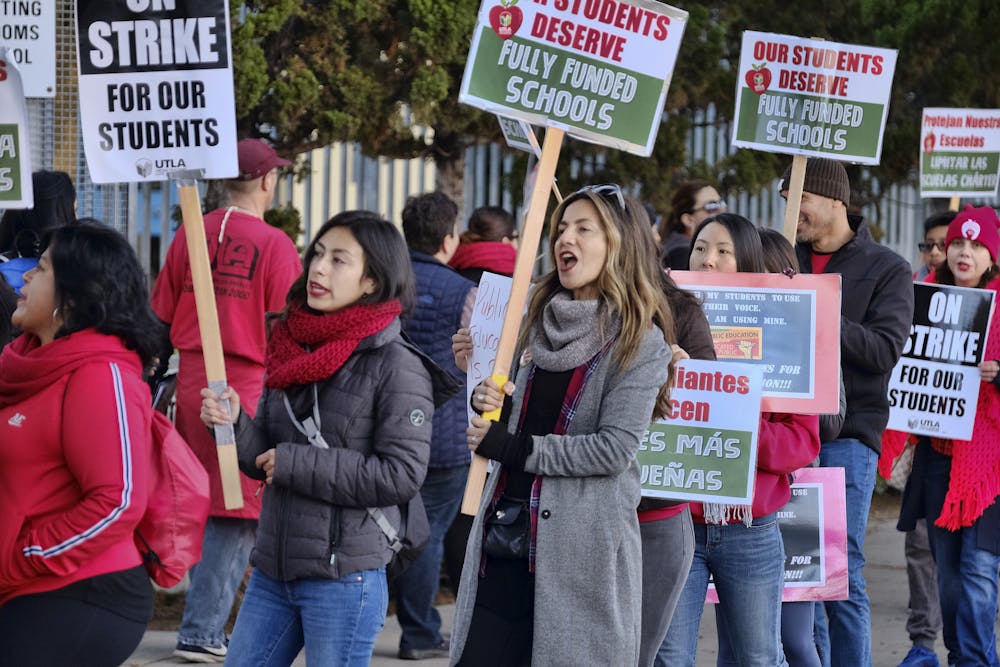 Striking Los Angeles Unified District teachers are joined by parents and students in front of Evelyn Thurman Gratts Elementary School in Los Angeles in January. Richard Vogel
The Oakland teachers’ union used a similar playbook. The union secured an 11 percent raise over the next four years and a modest reduction in class size by the 2021-22 school year. Additionally, the new contract lowers the counselor-to-student ratio, establishes new caseload limits for school psychologists and speech and language pathologists, and increases staffing levels at schools with 50 or more students who are new to the country – all provisions that will require the district to add more educators. Finally, the union secured a five-month pause on school closures and consolidations, which will maintain current teaching and support staff positions at those schools.
Strategy for charter schools
Not only are teachers’ union fighting for increased staffing levels, but they are also using contract negotiations to limit the transfer of teachers to non-union schools that pose a threat to their membership levels. Both teachers’ unions took a hard stance on charter schools in their negotiations. In Los Angeles, the teachers’ union called for an eight- to 10-month moratorium on new charter schools, something the Los Angeles Unified School District board cannot provide. However, the Los Angeles Unified School District agreed to endorse such a moratorium and lobby California’s governor to that end.
The Oakland teachers’ union secured a nearly identical commitment from the school district to also lobby the state legislature for the same moratorium.
Even while they attempt to limit charter school growth, the unions are also seeking to organize charter school teachers. Of the 277 charter schools in Los Angeles, 65 of them – or 23 percent – are organized by the Los Angeles teachers’ union. In addition, the new LA contract provides union leaders the opportunity to pick a “coordinator” to work with staff at charter schools that share a campus with a traditional public school. This is essentially a foot in the door to draw membership from the charter sector. In Oakland, only two of the 44 charters – or 5 percent – are unionized and are represented by the parent organization of the Oakland teachers union, the California Teachers Association.
All in all, our rough calculations suggest that the staffing provisions in the new Los Angeles contract could add over 1,500 members to the the Los Angeles teachers’ union’s membership. This equates to about a 5 percent increase in the union’s ranks of over 30,000 educators. The Oakland teachers’ union could get a similar boost.
In a post-Janus world, unions are showcasing the viability of the picket line as a way to win contracts that bolster membership. Not only that, because only union members can vote to authorize a strike, union leadership can leverage strike votes to petition – or pressure – non-union members to join the movement. The Los Angeles union reports adding over 1,000 members during their strike vote. The Denver union reports adding 250 of its 3,800 members during its authorization vote.
So why are teachers’ unions striking with increased frequency? Teachers’ unions are striking to fight for benefits their students need. But also – and perhaps more so – they are striking for membership they need to stay viable after Janus. Unions are fighting for their survival.
This article is republished from The Conversation under a Creative Commons license. Read the original article.

